




יומנים > יומן - מלא 12/01/1949


Places:
Be'er Sheva
Hebron
Lavi
Egypt
Rhodes
Bethlehem
Jerusalem
Negev
People:
The use of the photograph is subject to the Copyright Law, 2007
12.01.1949
224838
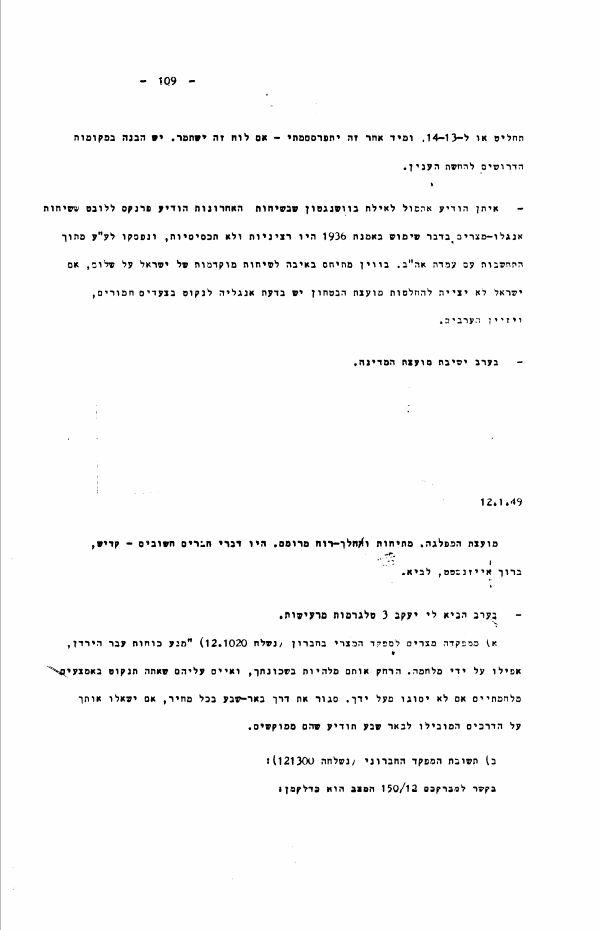
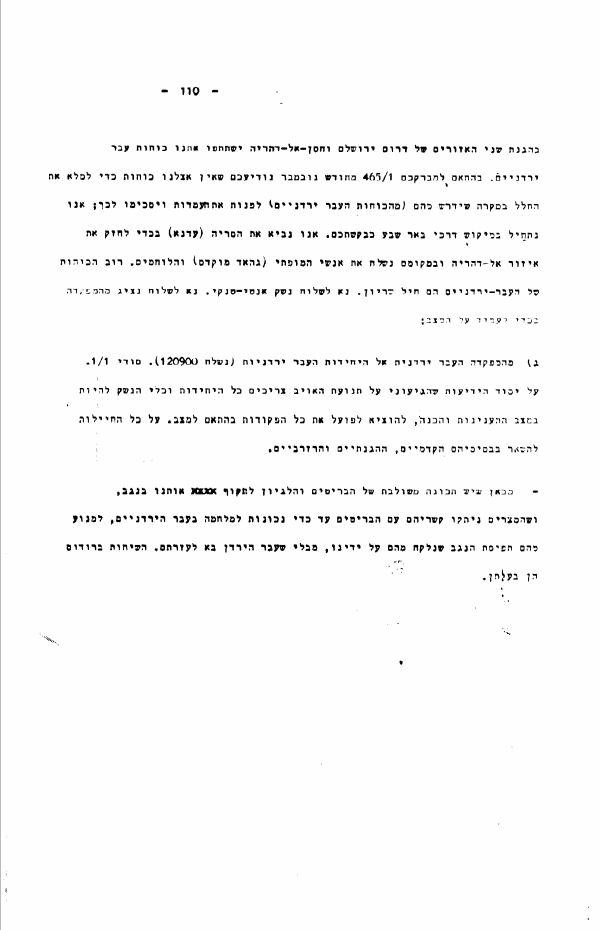
Wednesday, January 12, 1949 Party council. Tension and high spirits. There were remarks by important members – Kadish, Baruch Eisenstadt, Lavi. – In the evening Ya’akov [Dori] brought me 3 astonishing telegrams. A) From the headquarters [in] Egypt to the Egyptian commander in Hebron (sent 12.1020): “Block the Transjordanian forces, even by armed force. Keep them away from your surroundings, and threaten them with military measures if they do not draw back from your vicinity. Seal off the way to Beersheva at all costs. If they ask you about the roads leading to Beersheva, say: They’re mined.” B) The Hebron commander’s reply (sent 121300): “Re your cable 150/12 the situation is as follows: In defending the two areas of southern Jerusalem and Husn [sp.] al-Dhahiriya [the Judean Hills, from Bethlehem to Dhahiriya], Transjordanian forces will join us. Regarding your cable we wish to inform you that we do not have the forces to fill the void in the event that they (the Transjordanian forces) are requested to vacate their positions and they agree to this; we will start laying mines along the roads to Beersheba as you requested. We will bring the Saraya [sp.] [?] (from Idhna) in order to buttress the al-Dhahiriya area and in place of them we’ll send the mufti’s men (Jihad Muqaddas] and the fighters. Most of the Jordanian forces are armored corps. Please send anti-tank weaponry. Please send a representative from the headquarters to assess the situation. C) From the Transjordanian headquarters to the Transjordanian units (sent 120900). Confidential 1/1: “Based on reports I received regarding enemy movement, all the units and weapons should be in a state of alert and readiness, in order to carry out all the orders as determined by the situation. All the corps must remain in their forward, defensive, and reserve bases.” It follows that there is a joint plan of the British and the Legion to attack us in the Negev, and that the Egyptians severed ties with the British to the extent of that they are ready to go to war against the Transjordanians, to prevent them from capturing the part of the Negev taken from them by us, without Transjordan coming to their aid. The talks in Rhodes are timely. 224839 Thursday, January 13, 1949 I clarified the election arrangements with Gruenbaum. According to him, up to two days ago, 40,000 cards were distributed in Tel Aviv, 95,000 remained to be distributed, 25,000 cards are being distributed daily by 200 distributors. Tomorrow he’ll assess whether they’ll manage to complete the distribution – if not he’ll declare a curfew on Monday. In Jerusalem up to two days ago, 22,000 were distributed, 18,000 remain. In Haifa – 25,000, 45,000 remain, in the Sharon 29,000 were distributed, 15,000 remain. In Petah Tikva 10,000 were distributed, 4,000 remain. In the south and the Negev, 10,000 were distributed, 2,000 remain. In Rishon LeZion 6,000 [and] 3,000 remain, in Ramat Gan 3,000 [and] 22,000 remain, in Nazareth 10,000 [and] 13,000 remain. In total, as of the 11th of this month – 172,500 were distributed [and] 229,000 remain. In the army 38,000 were distributed as of yesterday, 37,000 remain, about 20,000 weren’t photographed, 6,500 were re-photographed, 13,500 remain to be photographed. Photographs will continue to be taken in the army until the 19th of the month. He complains about the appeals and the fact that they’re handling them like a regular trial and demanding a government appearance; he promised to speak with Rosenblüth about canceling the representation fee. He requests the participation of Gadna [Youth Battalions] on Monday at 7 p.m. I raised the question of a passerby; he promised to install a special voting booth. He’ll look into the matter of a few voting booths in a room. – Clarification of the police budget, Sheetrit, Kaplan, Sahar, in a proposal for 1949: 3,637 policemen, 200 of them officers, 3,100 other ranks, 200 (civilian) administrative staff, 70 cleaning staff. 7 technical crew, budget for six months P£ 1,899,836, of which 9,632 [is for] the minister’s bureau, police 1,765,798, prisons 124,406, 200 administrative staff P£ 23,964, 2,740 policemen P£ 265,110, 200 B sergeants – P£ 75,290, 160 A sergeants 25,050, 131 inspectors – P£ 27,018, 66 A inspectors 14,340, 33 district assistant inspectors 9,504, 20 deputy assistant inspectors 6,480, 7 district inspectors 2,712, 1 assistant inspector general 432, 1 deputy inspector general 528, 1 inspector general 900. The salary for an unmarried policeman begins at P£ 34 per month, maximum P£ 60 (for a wife 1.5[,] for each child 1.5). A policeman studies for 3 months (law, procedure, weaponry) [and undergoes] 3 months of practical experience. Sheetrit thinks that studies should be 6 months and experience 6 months, but not Sahar. He disagrees. The dispute over [wage] increases [?] has to do with the trial period – 6 or 12 months? During the trial period a policeman will receive P£ 34; after 6 months of experience P£ 39 (at minimum). The treasury proposed P£ 110,000 per month for the Ministry of Police; he’s prepared to add 45,000 per month – Sheetrit requests P£ 315,639 per month (Kaplan claims that the entire government budget is about 1 million per month). The difference is in the number of policemen: 3,700 per Sheetrit’s request, 2,200 per Kaplan’s proposal. Sheetrit claims that during recent months (September) there were 2,065 policemen. Since then the Yishuv has grown and its territory has expanded. In Tel Aviv there are 208 policemen, in Jerusalem 350; there are large areas without police – in Jaffa there are only 35 policemen, in Nazareth, Acre, Shfar’am, and Jaffa there are Arab policemen (about 45), receiving the same salary. – In the afternoon State Council. – After managing to catch the closing of the party council, I went up the hill [to the General Staff]. I found a cable from Moshe Dayan [saying] that Wilhelm [Abdallah al-Tall] invited him and Reuven to come to Shuni [?] to appreciate the sincerity of their desire for peace – for a half-hour conversation with the king. In the meantime Moshe arrived from Jerusalem. The invitation is for Sunday [January 16]. Moshe asked him about the significance of the Legion being ordered to be on standby. Wilhelm said that it doesn’t mean anything; it’s just the outcome of clashes in Beit Surik (a patrol of ours encountered an error patrol and they fired on each other). Moshe asked him about the English being invited – Wilhelm: “They weren’t invited; the English just came. Officially it’s framed as us inviting them.” – A cable came from [Walter] Eytan, [saying] that the following agenda has been agreed upon for Rhodes: A) Assurances regarding military attacks and national security. B) Implementation of the November 4 and 16 resolutions, including: 1) Faluja, 2) Demarcation of the armistice lines, 3) Withdrawal of forces, 4) Reduction of forces. C) Formulation of an armistice agreement, D) Signing initials to an armistice [agreement]. They began an informal discussion of Item A. – Yesterday M. Dayan suggested to Neuville [the French consul in Jerusalem] that he be the father of this proposal: Jerusalem [the Old City] would be divided. The Jews would have the Western section with the university and the Jewish Quarter and the Mount of Olives. In the latter two we won’t maintain armed forces. The road north of Jerusalem and the road in the south, to Bethlehem [would be] international. Neuville agrees to this. Neuville agrees to a corridor, is prepared to go to his government to persuade it to accept this. 224840 [Friday] January 14, 1949 Prof. Sukenik proposes Rabbi Berlin, Dr. Yosef, and Dr. Elias to serve on a committee that will assess Rosenblüth’s claims against Frumkin. I passed the proposal on to Rosenblüth – and he’s reviewing it. – Pinkas: the Defense Committee wants to conclude the matter of Gadna and clarify the questions regarding soldiers’ rehabilitation. – In answer to my question, [Ya’akov] Riptin announced in the Defense Committee that they [Mapam members] are opposed to the return of Arabs prior to peace with the states, and he’s in favor of making peace with the Arab states – only if they withdraw their invading forces from the country. – Rosenblüth doesn’t agree to Sukenik’s committee; he proposes Nir, Barth, and someone else. I suggested that he give me a list of 5-7 in Tel Aviv and such a list in Jerusalem so that I can select a committee of three. – [Abba] Eban cables (January 11, 1949) that the Frenchman on the [UN] Conciliation Commission wants 1) Jerusalem to be international, with Jewish autonomy in the new city. 2) A political arrangement for the problem of Arab refugees – their settlement in Arab countries and reparations from Israel. 3) An overall political arrangement – he’s inclined towards annexation by Transjordan. Believes that Israel is strong enough to withstand a strong neighbor. 4) Regarding borders he’s prepared to accept the current situation, but he’s inclined towards a special arrangement in Nazareth and Bethlehem. – I joined the platform committee in an effort to reduce and cut. But all I managed was to make one small addition in the opening, that “the appropriate borders of the state are not yet guaranteed and Jerusalem has not yet been included within the state.” – In the evening a cable came from Moshe Dayan. He spoke this morning with Abdallah [al-Tall]. The Egyptians know about our arrangement for an exchange of POWs in Egypt and agree to it; nevertheless, Moshe proposed that we return the Egyptian POWs – to Egypt. Abdallah agrees and wants to ask the king. [Moshe] informed him that we agree to meet with the king. It will apparently take place on Sunday. – Yigael and Eytan will return [from Rhodes] tomorrow at 3 p.m.